
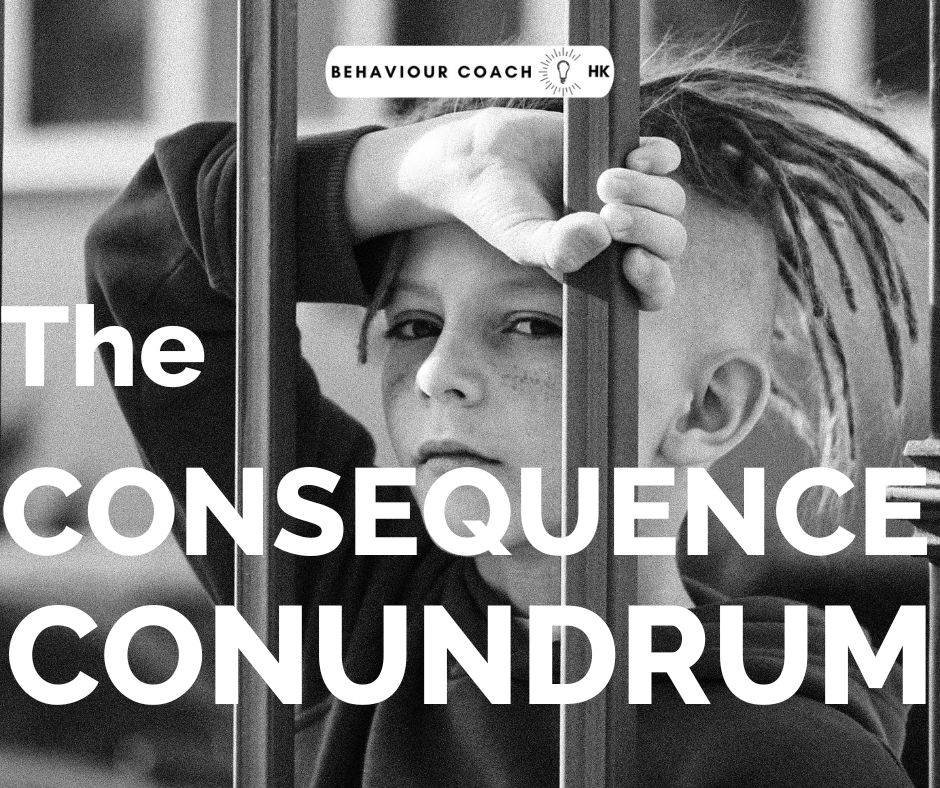
When children exhibit concerning behaviours, many parents quickly turn to consequences and punishments as tools for change. But what do these methods have to show for themselves?
Consequences: A Familiar Path
As parents, teachers & caregivers, we’ve all been there – your child misbehaves, and you respond with a consequence. It’s a commonly used strategy to convey that what they’ve done is not okay. But a lot of the time, the kid already knows that it’s not okay. So what are we trying to establish here? This is where the paradox begins – if the child already understands that their behaviour is unacceptable, why does it continue?
A Real-Life Example
Imagine a scenario: Your child habitually forgets to complete their homework. You’ve tried consequences like taking away privileges or giving extra chores. Yet, the problem persists and you’ve hit a brick wall. We often assume that the punishment doesn’t quite fit the crime and the kid just isn’t getting it. Resulting in us doubling down and hoping for the best. This rarely works with certain kids and often ends up alienating them from you.
Understanding Lagging Skills
Instead, we ought to shift our perspective. Rather than merely focusing on the behaviour, we should delve deeper into understanding why the behaviour occurs. Concerning behaviour is often the result of lagging skills (not lagging motivation). Afterall, “Kids do well if they can”. When the demands (expectations) of a situation supersedes their ability to respond, concerning behaviour manifests itself.
Getting to the Root Cause
Consequences and punishments don’t teach any skills or address any unsolved problems. Returning to our homework scenario, a CPS approach would involve understanding why your child struggles with homework. Perhaps they find it overwhelming, or they lack effective organizational skills. The goal is to identify the underlying problem, not just address the symptom (behaviours).
A Collaborative Solution
Once you’ve identified the unsolved problem, you can work together with your child to find a solution. In our example, this might involve helping your child develop better organization skills or breaking down their homework into manageable chunks.
Why Traditional Approaches Fail
Traditional consequences and punishments often fail because they don’t address the root cause of the behaviour. They focus on the surface, penalizing the child for actions they may not fully control. For kids with lagging skills, this can create frustration and resentment.
The Punishment Pitfall
Punishments can create a cycle of negative behaviour. When a child is continually punished for something, they struggle with, it doesn’t magically improve their skills. Instead, it can lead to a sense of hopelessness and defiance.
Building Skills, Not Resentment
CPS recognizes that kids with lagging skills need support, not punishment. It encourages skill-building rather than resentment-building. By working together to address the underlying problems, parents and children can develop a deeper understanding and trust.
The Choice is Ours
So, as parents and caregivers, we have a choice to make. We can stick to the familiar path of consequences and punishment, often leading to frustration for both parties. Or, we can embrace the CPS approach, diving deeper into understanding and collaborative problem-solving.
Conclusion: Rethinking Our Approach
Our choices as parents can make a significant impact on our children’s lives. Instead of relying on consequences and punishment, consider the power of empathy, understanding, and problem-solving. Collaborative & Proactive Solutions invite us to explore alternative avenues that not only address behaviour but also build essential skills and strengthen our relationships with our children. Isn’t it worth a try?